
If you’ve ever tried to measure something from a photo, you probably know how easy it is to get it wrong. One angle can trick your eyes. Shadows can distort size. And if the camera is low-quality or the image is taken from a strange angle, the whole thing becomes a guessing game.
That’s where good photogrammetry software steps in. And honestly, the secret to its accuracy comes down to one major thing: multi-view calibration.
It sounds like a mouthful, but don’t worry – it’s simpler than it sounds.
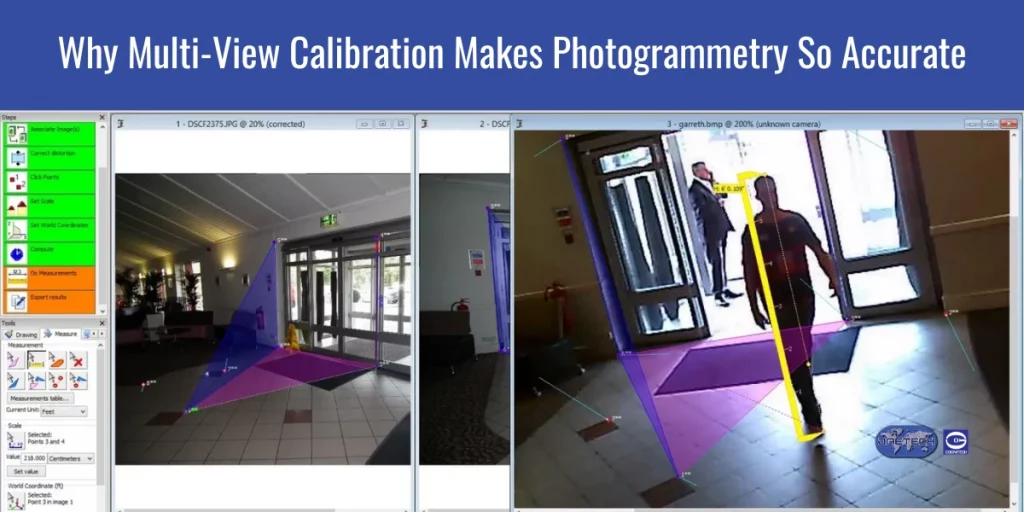
What Multi-View Calibration Actually Means
Think of multi-view calibration like looking at a scene from different angles. When you only have a single photo, your software has to guess what the real shape and size of things are. It uses lines and vanishing points from buildings or other man-made objects to estimate distances. This method is called single-frame metrology. And it’s pretty much all the competition relies on today.
But that guessing has limits. A single frame doesn’t tell you if something is hidden, tilted, warped, or closer than it looks. It’s basically the software doing its best with very limited information.
Multi-view calibration changes the game. Instead of depending on one angle, the software pulls information from several views or frames. Even if you don’t have the original camera or angle, a strong system can still rebuild the scene much more accurately.
Why Multi-View Calibration Works So Well
When your photogrammetry software can look at multiple views, it has more clues to work with. Think of it like solving a puzzle but getting extra pieces. Suddenly everything fits better.
Multi-view calibration lets the software:
- See depth more clearly
- Understand the true shape of objects
- Compare details between different angles
- Reduce errors caused by bad lighting or camera tilt
- Rebuild the scene with real, measured accuracy
This approach is especially important in forensic work, where measurements have to be exact. A small mistake can lead to big misunderstandings.
The Advantage of 3D MultiView Measure
Here’s where the difference really shows.
Automeasure 64 uses 3D MultiView Measure, and this tool is honestly on another level. It can measure height, area, and distance from a single scale measurement. The best part? It can do it even if the original camera source isn’t available.
Most other tools can’t do this. They’re stuck with the old single-frame method, which tries to estimate sizes based on the way straight lines appear in the image. It works okay with perfect photos and perfect angles. But real crime scenes are not perfect. They’re messy. They’re complex. Sometimes you only have the footage you can get.
Multi-view calibration cuts through that problem. It doesn’t need the perfect setup. It builds accuracy from the raw information, even when conditions aren’t ideal.
Why This Matters in Crime Scene Reconstruction
When you’re reconstructing a crime scene, every detail counts. You’re not just building a model. You’re trying to understand what happened, how it happened, and what the evidence really shows.
With strong photogrammetry software that uses multi-view calibration, you get:
- True 3D models
- Better accuracy
- More reliable measurements
- Fewer assumptions
- Less room for error
This is why many agencies prefer tools like Automeasure 64. It’s built to handle the real world – not just textbook-perfect frames.
A Real-World Example
Imagine you’re working with blurry security footage. A suspect’s height needs to be measured. The camera angle is terrible, and the scene has no clear reference lines. Most single-frame tools would struggle.
But with multi-view calibration and 3D MultiView Measure, the system can still pull together accurate height and distance values from the available frames. It puts the evidence back into context, and that can make or break the case.
Ready for More Accurate Crime Scene Measurements?
Get the tools built for real forensic work. Try Automeasure 64 and see how multi-view calibration can change your case results.
Learn MoreThe Bottom Line
When people talk about accuracy in photogrammetry, they often think it’s all about camera quality or fancy lenses. But the real power comes from how the software interprets the scene. Multi-view calibration brings more information to the table. It reduces guesswork and creates solid, dependable measurements.
And in forensic work, that difference matters.
If your goal is better reconstructions, clearer evidence, and more confidence in your results, then multi-view calibration isn’t optional. It’s essential.
FAQs
1. What is multi-view calibration in photogrammetry?
Multi-view calibration uses information from several angles or frames to measure a scene more accurately. It helps the software build a true 3D view instead of guessing from one image.
2. Why is multi-view calibration better than single-frame metrology?
Single-frame metrology has to estimate sizes from one photo. Multi-view calibration pulls info from multiple views, which gives cleaner, stronger, and more reliable measurements.
3. Can multi-view calibration work without the original camera details?
Yes. With tools like Automeasure 64’s 3D MultiView Measure, you can still get accurate height, area, and distance values even if you don’t know the original camera source.
4. Why is multi-view calibration important for crime scene reconstruction?
Crime scenes are rarely perfect. Multi-view calibration helps rebuild the scene with real accuracy, even when lighting, angles, or video quality aren’t ideal. It makes the forensic results more trustworthy.