
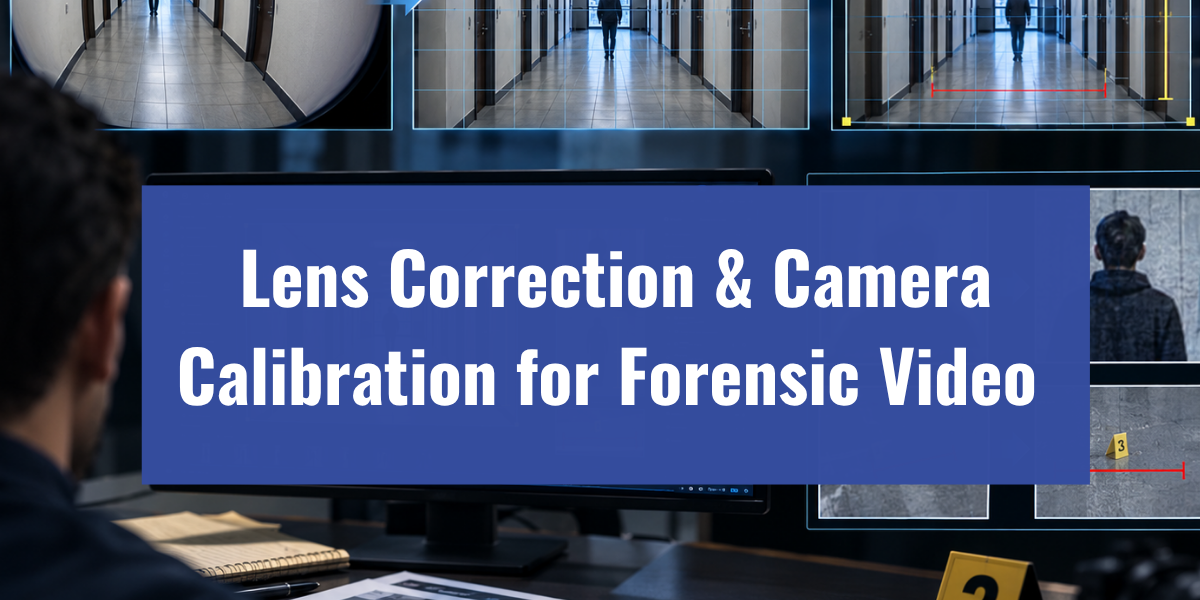
A hallway camera with a wide-angle lens doesn’t just capture a scene it bends it. Straight edges curve. Distances near the frame border compress or stretch. To the human eye watching a live feed, this barely registers. To an analyst relying on digital forensics to measure a suspect’s height or the distance between two objects, that distortion can turn a clean piece of evidence into a liability.
This is where lens correction and camera calibration stop being technical footnotes and start being case-critical steps. Get them wrong, and a measurement pulled from footage can be challenged or thrown out the moment a defense expert looks closely at the source image. Get them right, and that same footage becomes digital evidence strong enough to hold up as a defensible, court-ready exhibit.
This guide breaks down what each process does, where they differ, and how to apply them without turning a routine review into a multi-week bottleneck.
What Lens Correction Actually Fixes
Every lens introduces some degree of optical distortion, and the cheaper or wider the lens, the more pronounced it usually is. The two most common types of analysts run into:
- Barrel distortion — straight lines bow outward, common in wide-angle and action-camera lenses.
- Pincushion distortion — straight lines bend inward, more common in telephoto lenses.
Lens correction software identifies the distortion pattern specific to a lens and mathematically reverses it, straightening lines and restoring the geometry of the scene. Without this step, anything measured directly off the raw frame in a doorway width. A vehicle’s position relative to a curb carries built-in error that grows the further an object sits from the center of the frame.
What Camera Calibration Adds
Lens correction fixes the shape of the image. Camera calibration goes further: it establishes the actual mathematical relationship between points in the real-world scene and pixels in the image, accounting for focal length, camera position and angle, and known reference points used to scale the image accurately.
Where lens correction answers “is this image geometrically accurate?”, calibration answers “what do these pixels correspond to in real-world units?” You need both to go from footage to a measurement you’d be comfortable defending under cross-examination.
Why Skipping This Step Is a Bigger Risk Than It Looks
An uncorrected, uncalibrated frame can still look convincing on a monitor — that’s exactly what makes it risky. In casework, this shows up in three ways: height and distance estimates that don’t hold up, downstream photogrammetry errors that compound, and evidentiary challenges when an opposing expert asks whether the footage was corrected before measurements were taken.
A Practical Workflow
Identify the source camera and lens, apply lens correction first, calibrate using known reference points, cross-check the result against a second reference where possible, and document every step — the correction model used, the reference objects, and the margin of error. That documentation is often what gets a measurement accepted as evidence.
Manual Correction vs. Purpose-Built Software
Analysts can approximate lens correction manually, but it’s slow, inconsistent between operators, and hard to document evidentiary standards. Purpose-built video enhancing software handles distortion modeling and calibration in a structured, repeatable workflow and logs the process for later review.
Lens correction and camera calibration aren’t extra steps to skip when time is tight — they’re the difference between a measurement that holds up and one that gets picked apart. Correct the geometry first, calibrate against known references second, document the whole way through.
FAQ
- What’s the difference between lens correction and camera calibration?
Correction fixes geometric distortion; calibration maps the corrected image to real-world measurements. - Can distortion affect facial identification, not just measurements?
Yes — edge distortion can subtly alter facial proportions relevant to identification comparisons. - How much error does uncorrected distortion introduce?
It varies by lens and by how far the subject sits from frame center. - Is specialized software required?
General tools can approximate correction, but purpose-built forensic tools document the process to evidentiary standards. Teams new to this often start with a forensic investigator course before applying it to live casework. - Does calibration need the physical camera?
It’s more accurate with it, but known reference objects can substitute.